

National Curriculum (England) · Year 3
Year 3 Spelling List
Half of the Year 3 and 4 statutory word list, the everyday half, in game-sized groups.
Year 3 (ages 7–8, Key Stage 2) is roughly 2nd grade in the US. If you're following a US school, see our 2nd grade lists. The game is in English and teaches English spelling.
50 words to start in Year 3
- address
- answer
- appear
- arrive
- believe
- breath
- breathe
- build
- busy/business
- caught
- centre
- circle
- decide
- different
- early
- earth
- eight/eighth
- enough
- famous
- favourite
- February
- fruit
- group
- guard
- guide
- heard
- heart
- height
- island
- learn
- length
- minute
- notice
- often
- potatoes
- promise
- quarter
- question
- remember
- sentence
- special
- straight
- strange
- suppose
- surprise
- though/although
- thought
- through
- weight
- woman/women
The full Years 3 and 4 list
These 50 plus the 50 on the Year 4 page make up all 100 statutory words for Years 3 and 4. Brackets show a longer form to learn too: accident(ally) means accident and accidentally.
What Year 3 spelling covers
The National Curriculum gives one statutory word list for Years 3 and 4 together: 100 words. It doesn't say which year each word belongs to, so schools split it their own way. We've put the shorter, more everyday words (answer, build, heart, often) here and the longer ones on the Year 4 page. If your school sends home its own half, use that.
Years 3 and 4 also cover prefixes (dis-, mis-, in-, il-, im-, ir-, re-, sub-, inter-, super-, anti-, auto-), the suffixes -ation, -ly and -ous, endings like -sure and -ture (measure, picture), -tion, -sion, -ssion and -cian, y in the middle of words (myth, gym), ou as in young, ch as in scheme and chef, -gue and -que (league, unique), the possessive apostrophe after plurals (girls') and homophones such as accept/except and heel/heal.
Play them in groups
5 groups, about ten words each. Each link opens all fourteen mini games using only those words; missed words come back until they stick.
| Group | Words | |
|---|---|---|
| 1 | address, answer, appear, arrive, believe, breath, breathe, build, busy, business, caught | Play group 1 |
| 2 | centre, circle, decide, different, early, earth, eight, eighth, enough, famous, favourite | Play group 2 |
| 3 | February, fruit, group, guard, guide, heard, heart, height, island, learn, length | Play group 3 |
| 4 | minute, notice, often, potatoes, promise, quarter, question, remember, sentence, special, straight | Play group 4 |
| 5 | strange, suppose, surprise, though, although, thought, through, weight, woman, women | Play group 5 |
Play group 1 now
Each word is read aloud, then your child spells it to dig up treasure, fire cannons or catch letters.
Year 3 · group 1
Free to play · no signup · works on phones, tablets and computers
How to learn the Year 3 words
The curriculum's own advice: once busy is learnt, business is busy + ness with the y changed to i. Once appear is learnt, disappear is just dis + appear.
Breath is the noun (one syllable, short e); breathe is the verb (the e on the end makes the ea say its name). Say take a breath, then breathe out.
Point out the word hiding inside: h-ear-t, l-ear-n, h-ear-d. Then the ear stops being a guess.
Print the full Year 3 and 4 list
Download the list as a PDF
All 100 statutory words for Years 3 and 4, A to Z, on one page: this page's 50 and the 50 on the Year 4 page.
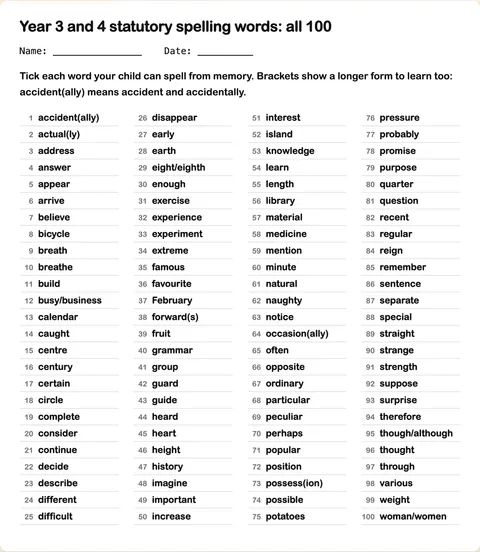 Year 3 and 4 statutory spelling words
Printable spelling test
Look, say, cover, write, check
Spellcove is in English and was made in the US, so our own grade lists use American spelling (color, favorite). The games and printables on this page don't: they use the words exactly as England's National Curriculum spells them, so centre, favourite and neighbour are marked right.
Questions
Is this the official list?
The words are; the split is ours. All 100 words come from the statutory list in the spelling appendix for Years 3 and 4.
How many spellings a week in Year 3?
Most schools send home 8 to 12 a week. At ten a week, the 50 words here take a term and a half, with time left for review.
We speak Arabic at home. How can I help with English spellings?
You don't need perfect English to help. Spellcove reads every word on these lists aloud in a recorded English voice, so your child hears each word clearly without you having to say it. Two things are worth watching. Written Arabic usually leaves out short vowels, so children sometimes skip vowel letters in English (hrt for heart); ask them to clap the beats and check each beat has a vowel. Arabic has no p sound, so p and b can swap. Our guide for parents in Arabic covers a weekly routine with the school list and these common mistakes.
What US grade is Year 3?
Year 3 (ages 7–8, Key Stage 2) is roughly 2nd grade in the US. UK children start school younger, so a Year 3 child is usually in 2nd grade in the US.
Is it free?
Yes. The game plays free in the browser with no sign-up and no adverts, and the sheets print as often as you like. The Spellcove app for iPhone has one free voyage a day; a subscription adds unlimited play and saved lists.


Take the cove with you
The Spellcove app adds what a browser can't: offline play for car rides with the voice built in, a parent view of which words have stuck, your own word lists saved on the phone, and a treasure shelf to fill. One voyage a day is free; a subscription unlocks the rest.
Download on theApp Store